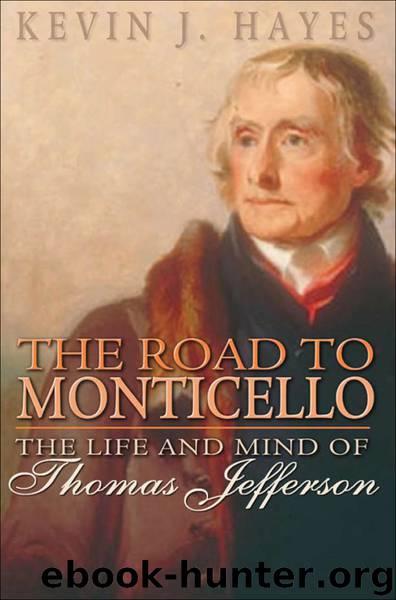
The Road to Monticello by Kevin J. Hayes
Author:Kevin J. Hayes [Hayes, Kevin J.]
Language: eng
Format: epub
Publisher: Oxford University Press USA - OSO
Published: 2008-06-15T04:00:00+00:00
I observe the hog of this country (Westphalia), of which the celebrated ham is made, is tall, gaunt, and with heavy lop ears. Fatted at a year old, would weigh 100. or 120. lb. At two years old, two hundred pounds. Their principal food is acorns. The pork fresh sells at 2½ d sterl. the lb. The ham ready made at 5½ d sterl. the lb. 106 lb of this country is equal to 100. lb of Holland. About 4 lb of fine Holland salt is put on 100 lb of pork. It is smoked in a room which has no chimney. Well-informed people here tell me there is no other part of the world where the bacon is smoked. They do not know that we do it. Cologne is the principal market of exportation. They find that the small hog makes the sweetest meat.26
The amount of space in his travel journal Jefferson devoted to West-phalian ham compared to the amount of space he devoted to the art gallery should not be interpreted as a personal preference. Instead, these varying descriptions suggest a literary priority. From his perspective, a disquisition on painting was much less useful in a travelogue than a record of the processing and marketing of pork. Such practical information he could put to use himself at Monticello. Furthermore, he could share what he learned of hogs and ham with farmers throughout Virginia. The contrast between the comments on art and those on farming in “Notes of a Tour through Holland and the Rhine Valley” shows the focus and purposefulness with which Jefferson recorded his travel experiences.
Staying at a tavern called the Holy Ghost in Cologne, he remained there long enough to notice several incongruities. The city had much commerce yet many poor people. Though Protestant merchants controlled the markets, Catholics controlled the city government and placed severe limits on the Protestants’ commercial enterprises. Recently, the Catholic-dominated Cologne legislature had licensed the Protestants to erect a church, but lawmakers were now threatening to revoke this privilege. Jefferson saw Cologne as a negative example that confirmed the importance of the separation of church and state: there can be neither freedom nor progress while the precepts of the church, any church, continue to influence the policies of a nation.
Despite recent storms, the roads remained in good condition until Bonn, after which clay roads predominated. When these clay roads got wet, they became, in Jefferson’s words, “worse than imagination can paint.” At Coblenz, he stayed at L’Homme Sauvage or, as it was also known, The Wildman, a very good tavern kept by a very good tavernkeeper who served very good bread. During his stay at Coblenz, this gracious tavernkeeper accompanied Jefferson to a nearby winery, where he introduced him to a Moselle expert. Consequently, Jefferson drafted a lengthy description of Moselle wine, one of many such descriptions that appear in his travelogue. After a fine breakfast roll reminiscent of the French rolls he had enjoyed in Philadelphia, Jefferson left L’Homme Sauvage with a sense of civility.
Download
This site does not store any files on its server. We only index and link to content provided by other sites. Please contact the content providers to delete copyright contents if any and email us, we'll remove relevant links or contents immediately.
4 3 2 1: A Novel by Paul Auster(12405)
The handmaid's tale by Margaret Atwood(7773)
Giovanni's Room by James Baldwin(7354)
Big Magic: Creative Living Beyond Fear by Elizabeth Gilbert(5780)
Asking the Right Questions: A Guide to Critical Thinking by M. Neil Browne & Stuart M. Keeley(5779)
Ego Is the Enemy by Ryan Holiday(5455)
The Body: A Guide for Occupants by Bill Bryson(5103)
On Writing A Memoir of the Craft by Stephen King(4948)
Ken Follett - World without end by Ken Follett(4740)
Adulting by Kelly Williams Brown(4582)
Bluets by Maggie Nelson(4565)
Eat That Frog! by Brian Tracy(4546)
Guilty Pleasures by Laurell K Hamilton(4455)
The Poetry of Pablo Neruda by Pablo Neruda(4113)
Alive: The Story of the Andes Survivors by Piers Paul Read(4037)
White Noise - A Novel by Don DeLillo(4019)
Fingerprints of the Gods by Graham Hancock(4009)
The Book of Joy by Dalai Lama(3996)
The Bookshop by Penelope Fitzgerald(3857)
